
Book 1 · Discussion & activities
Barnaby the Bashful Badger
A small welcome can make room for friendship.
Barnaby watches the Thompson children from his burrow. Emma’s gentle wave gives him a beginning, and friendship grows at a pace he can manage.
Read the story first, then choose a question. These suggested answers invite conversation; they do not replace the child’s own ideas.
01 · Remember the story
What small gesture helped Barnaby begin to feel welcome?
An answer to explore
Emma noticed him, smiled, and waved. Barnaby first smiled back, then later waved and said hello.
Return to the story: Compare pages 10 and 12–14. What changes in Barnaby’s response?
02 · Think a little deeper
Why might a gentle wave be helpful to someone who feels shy?
An answer to explore
A wave can offer a welcome without asking someone to speak immediately. It gives them room to respond when they feel ready.
Follow-up: Did Barnaby have to become the loudest person to belong? Notice that the friends also enjoy quiet moments together on page 16.
03 · Carry it with you
How could you welcome someone without rushing them?
An answer to explore
With guidance from a parent, teacher, or trusted adult, you could smile, wave, or offer a place in an activity. Give the person time and respect their answer.
Follow-up: What could you do if they would rather watch for a while?
For the adult: belonging without pressure
Distinguish an invitation from a demand. Emma’s small gesture opens a possibility; Barnaby’s response unfolds over several visits. Invite children to find evidence of that gradual change rather than treating shyness as a flaw to correct.
The story also connects belonging with contribution. On page 17, Barnaby asks to help build the little woodland houses. Ask how being welcomed as a participant differs from simply being noticed. His quiet nature remains compatible with friendship.
When connecting the story to real life, keep introductions and new friendships within a trusted adult’s guidance. Children can decline an invitation and still deserve kindness.
Try it together · 2 minutes
Practice a gentle welcome
Use two toys. One offers a wave or an invitation; the other chooses to join, watch, or say “Not yet.” Practice a kind response to each choice.
Notice the picture
A small change
Compare pages 10 and 12. What do you notice about Barnaby’s face and paw? Ask the child to point to a clue before explaining what it might mean.
Color & talk
A little wave from Barnaby
Color Barnaby’s gentle wave. His small outlined forehead patch can be colored reddish brown. Then talk together about one small way to help someone feel welcome.
One page · US Letter (8½ × 11 inches) · Black-and-white
Open & print coloring page Download PDF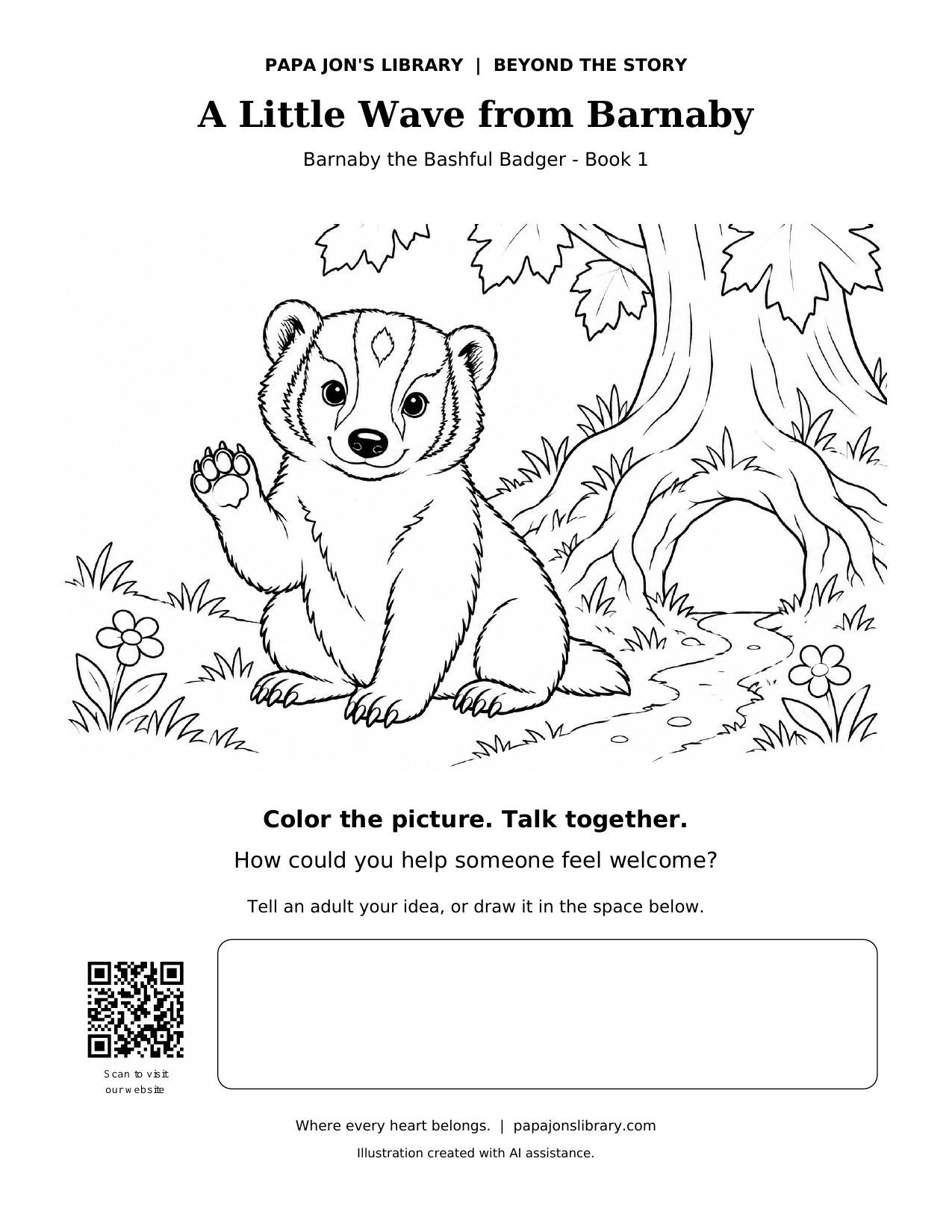
Adapt the conversation to your child or group
Younger children: Point to Barnaby’s waving paw and practice a small wave with a familiar adult. Accept pointing, gestures, or a few words.
Older children: Ask for story evidence of growing trust. Discuss how to offer inclusion while respecting someone’s wish to wait.
Follow the child’s interests and communication needs. Sharing a personal experience is optional.
Read further · For adults
Continue your own learning
- Reading Rockets · Dialogic Reading: An Effective Way to Read Aloud with Young Children
Grover J. Whitehurst explains ways to invite and expand children’s contributions during shared reading.
- NAEYC · Teaching Emotional Intelligence in Early Childhood
Tominey, O’Bryon, Rivers, and Shapses discuss recognizing feelings and exploring their causes, including through book characters.
- NAEYC · Building Social and Emotional Skills at Home
Practical ideas for families to explore feelings, relationships, and cooperation.
These references support the adult discussion approach. They do not evaluate or endorse Papa Jon’s Library books.