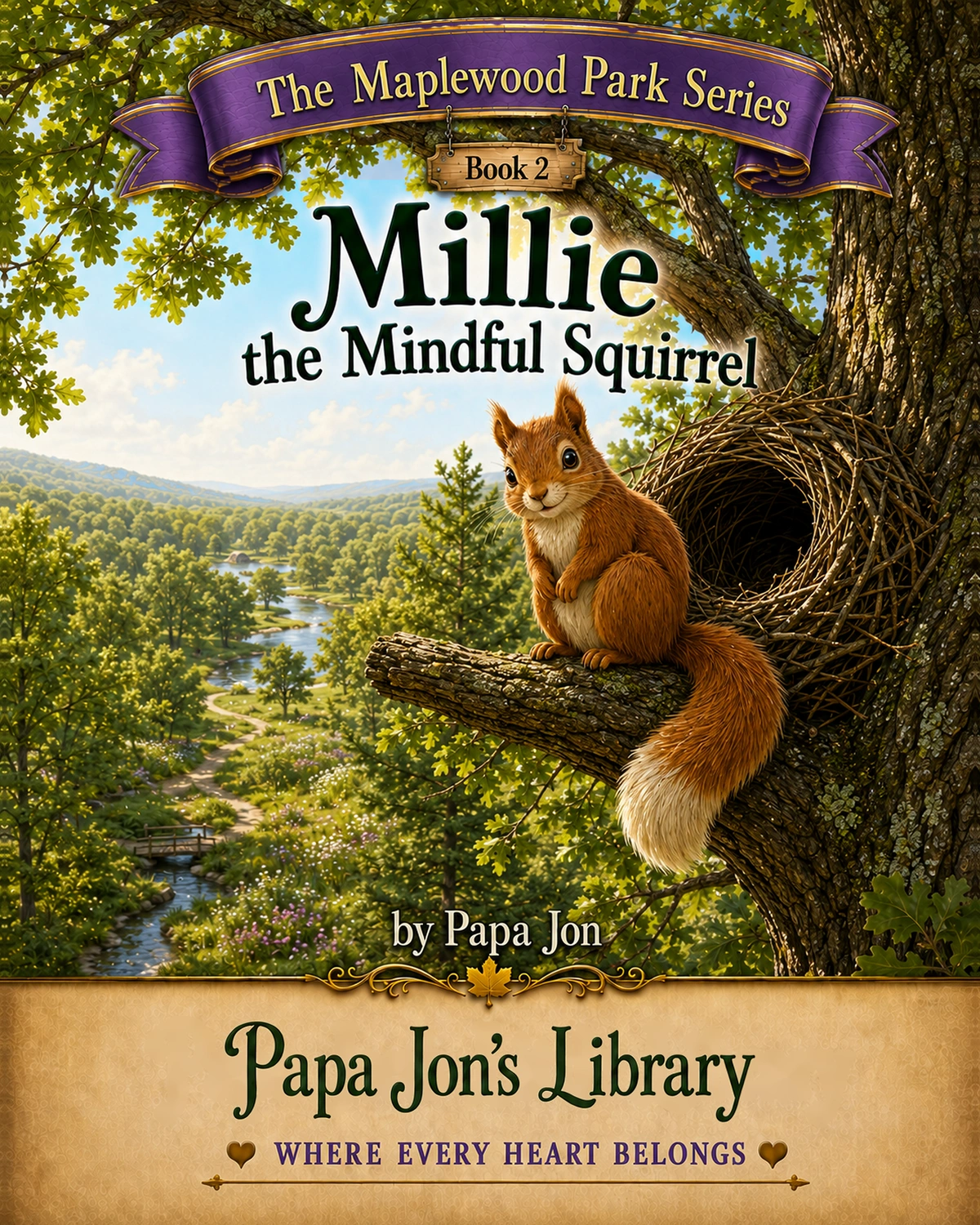
Book 2 · Discussion & activities
Millie the Mindful Squirrel
There is more to enjoy when we give a moment our attention.
Millie delights in the wonders around her. When she moves quickly from one discovery to another, she realizes she has hardly enjoyed any of them. Returning to a pine cone, she discovers what a little time can reveal.
Read the story first, then choose a question. Children can share a thought, point to a picture, or take time to listen.
01 · Remember the story
What did Millie return to when she decided to enjoy one thing for now?
An answer to explore
She returned to the pine cone, sat quietly, and held it in her paws. She noticed its scales, tiny seeds, and rough edges, and heard the breeze in the pine tree.
Return to the story: Look at pages 9–10. What could she see, feel, and hear?
02 · Think a little deeper
The pine cone had not changed. What had changed for Millie?
An answer to explore
She gave herself time to look closely and enjoy it. Her attention changed, so she noticed details she had missed.
Follow-up: Did she have to stop being curious? No—she could enjoy one discovery now and another later.
Return to the story: Compare pages 6 and 10.
03 · Carry it with you
What ordinary thing could you spend a little time noticing today?
An answer to explore
A leaf, a familiar toy, a drawing, or a sound nearby. Choose one and see what you notice when you give it a little time.
Follow-up: What did you notice that you had not noticed before? There is no required number of discoveries.
For the adult: attention without losing curiosity
Millie’s curiosity is a strength. Her story explores the difference between briefly noticing something and staying with it long enough to appreciate its details. Ask children to identify what changes in her actions, rather than labeling her earlier excitement as bad behavior.
Page 11 adds a useful distinction: Millie finishes one quiet moment and then becomes ready for something new. Attending to the present does not mean ignoring other people or never changing activities.
Keep the conversation playful and brief. Stillness and eye contact are not requirements for participation; children can notice through movement, pointing, touching a suitable object, or describing a sound.
Try it together · 2 minutes
One small discovery
Choose a familiar, safe object together. Ask, “What do you notice?” Wait, then ask, “Anything else?” Compare your observations without turning it into a contest.
Notice the picture
Follow her attention
Compare pages 6 and 9. What is Millie looking at or holding? Invite the child to show a clue about the change in her attention.
Color & talk
One small discovery with Millie
Color Millie studying her pine cone. The outlined tip of her tail can be colored cream. Then look closely at something familiar together.
One page · US Letter (8½ × 11 inches) · Black-and-white
Open & print coloring page Download PDF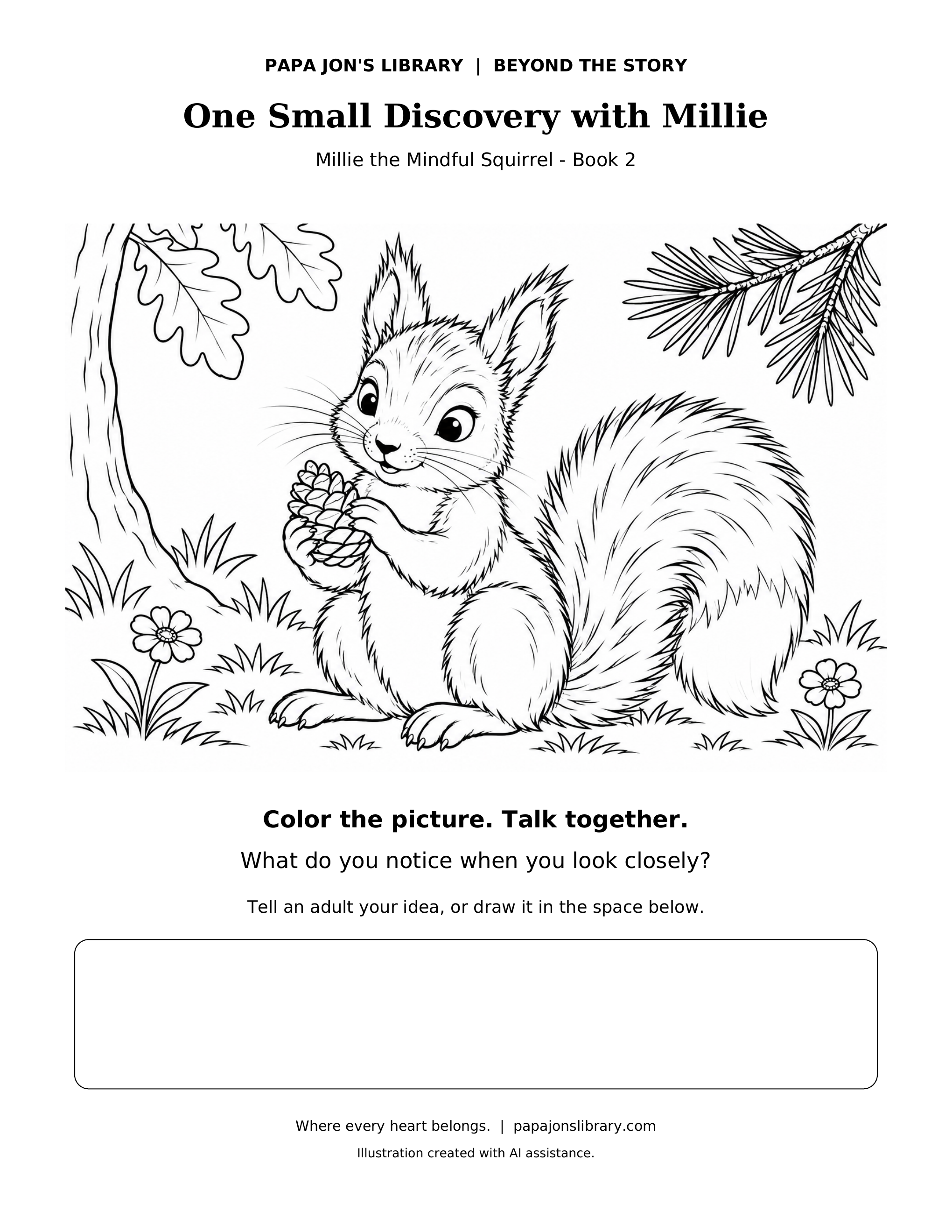
Adapt the conversation to your child or group
Younger children: Ask the child to point to the pine cone and name or show one detail. Model a simple observation, then let them choose what to notice.
Older children: Compare what Millie noticed before and after pausing. Ask why the same object could feel like a different experience.
Follow the child’s communication needs and interest. This is an invitation to explore together.
Read further · For adults
Continue your own learning
- Reading Rockets · Dialogic Reading: An Effective Way to Read Aloud with Young Children
Grover J. Whitehurst explains ways to invite and expand children’s contributions during shared reading.
- NAEYC · Teaching Emotional Intelligence in Early Childhood
Tominey, O’Bryon, Rivers, and Shapses discuss recognizing feelings and exploring their causes, including through book characters.
- NAEYC · Building Social and Emotional Skills at Home
Practical ideas for families to explore feelings, relationships, and cooperation.
These references support the adult discussion approach. They do not evaluate or endorse Papa Jon’s Library books.