
Book 7 · Discussion & activities
Tilly the Thoughtful Turtle
Kindness grows through asking and listening.
Tilly thinks quiet Jim may be lonely. When she asks, she discovers he is waiting for tadpoles. Listening helps her offer the companionship he actually wants.
Read the story first, then choose a question below. Open “An answer to explore” when you would like a little guidance.
01 · Remember the story
What was Jim waiting to see?
An answer to explore
He was waiting for tiny tadpoles to come out from beneath the pond plants. He wanted the water to remain still.
Return to the story: Look together at pages 14 and 19. What do Jim’s words and the pictures help us understand?
02 · Think a little deeper
Why did Tilly’s kind ideas miss what Jim needed?
An answer to explore
Tilly cared about Jim, but she guessed that he was lonely. She did not yet know what he was doing. When she asked and listened, she could change her approach.
Follow-up: Does being quiet always mean someone is sad? What else might it mean?
Return to the story: Compare pages 6 and 13–17.
03 · Carry it with you
What could you ask before trying to help someone?
An answer to explore
“Would you like some help?” or “What would help you?” Then give the person time to answer. They might want help, quiet company, or time on their own.
Follow-up: How could we respond kindly if their answer is different from what we expected?
For the adult: noticing, guessing, and understanding
Tilly’s story invites children to distinguish an observation (“Jim is quiet”) from an interpretation (“Jim is lonely”). Ask which part Tilly could see and which part she needed to check. This creates room for perspective-taking: another person may have a purpose or preference we cannot know until we listen.
Her apology also gives us a small example of repair. She acknowledges the ripples she caused, asks whether Jim wants her to stay, and changes what she does. Invite children to notice the changed action as well as the words.
Try it together · 2 minutes
Ask before you help
One person draws a simple picture. A partner asks, “Would you like help?” If the answer is yes, ask what kind. Respect the answer, then switch roles.
Notice the picture
What caught Jim’s attention?
Revisit page 12. Where is Jim looking? Let the child point to a clue before explaining what it might mean.
Color & talk
A quiet moment with Tilly
Color Tilly watching tadpoles. The small outlined oval on her shell just behind her head can be colored pale gold. Then talk together: “What could you ask before helping a friend?”
One page · US Letter (8½ × 11 inches) · Black-and-white
Open & print coloring page Download PDF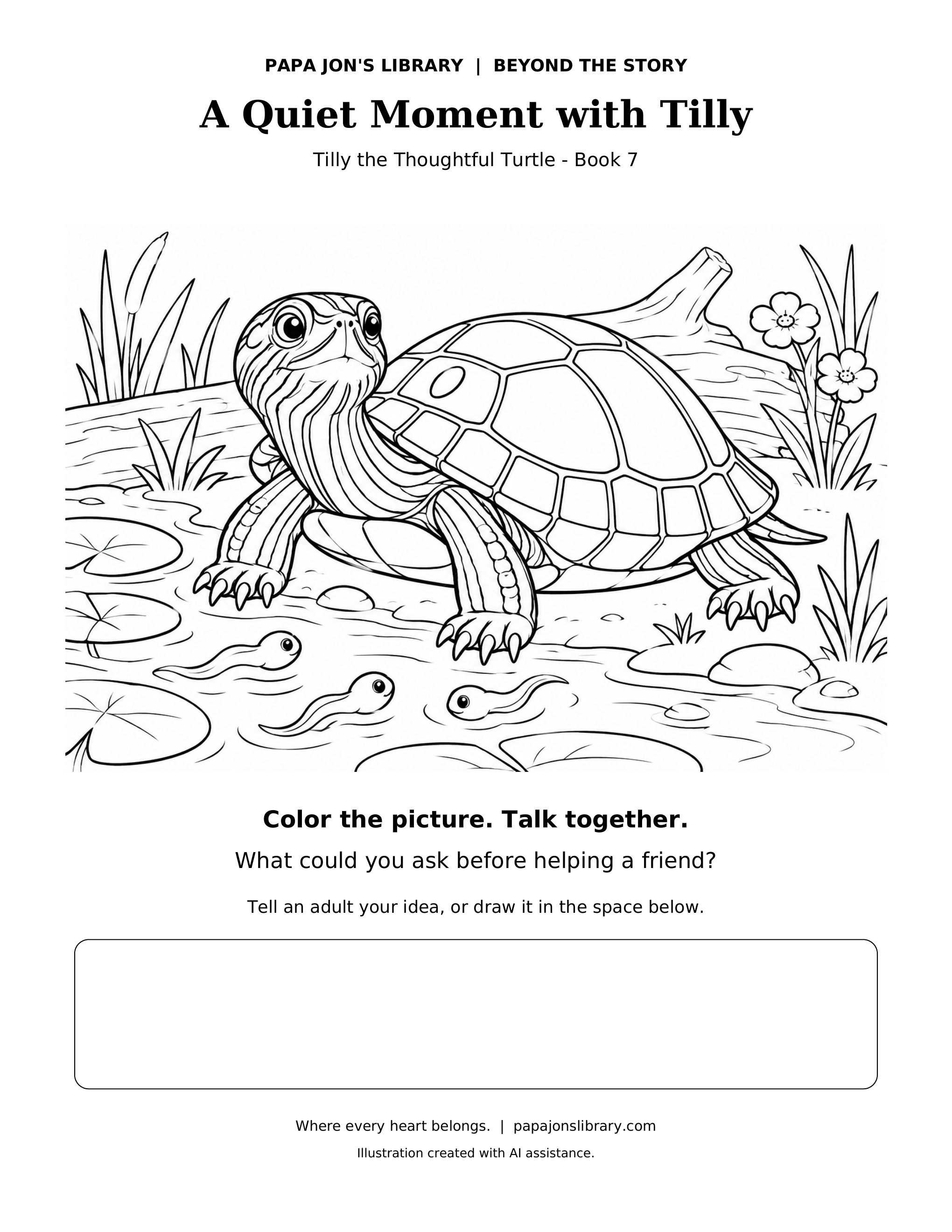
Adapt the conversation to your child or group
Younger children: Offer one short question, accept pointing or a few words, and model a simple phrase such as “May I help?”
Older children: Invite reasons and story evidence. Ask how Tilly’s understanding changes, or compare helping with deciding for someone else.
Use these as flexible starting points. Follow the child’s interests and communication needs.
Read further · For adults
Continue your own learning
- Reading Rockets · Dialogic Reading: An Effective Way to Read Aloud with Young Children
Grover J. Whitehurst explains ways to invite and expand children’s contributions during shared reading.
- NAEYC · Teaching Emotional Intelligence in Early Childhood
Tominey, O’Bryon, Rivers, and Shapses discuss recognizing feelings and exploring their causes, including through book characters.
- NAEYC · Building Social and Emotional Skills at Home
Practical ideas for families to explore feelings, relationships, and cooperation.
These references support the adult discussion approach. They do not evaluate or endorse Papa Jon’s Library books.